
Exhibition Day Rochdale Canal, Todmorden
This is now the proposed weekend for the exhibition. As I’m continuing to select and post, it is clear that the exhibition (even in virtual form) is not yet complete.
Today’s image is from a photograph taken towards the end of an early morning walk, in car park near the Rochdale Canal in Todmorden.
Rochdale Canal, Todmorden. 28 April 2017 08:25. Photo-etching 2019
What drew me to this point was both the pattern and a piece of coloured glass embedded in a corner of the puddle.
The underprinting in this series is differs slightly from most of others, as a mask is used, leaving parts of paper visible, as no ink is applied.
Rochdale Canal, Todmorden. 28 April 2017 08:25. Photo-etching and monoprint 2019
I developed this further with two complementary masks and two underprinted monoprint layers. This is brings me closer to the idea that first drew me to this patch of ground- an expanse of broken tarmac with a bright fragment of glass shining through.
Rochdale Canal, Todmorden. 28 April 2017 08:25. Photo-etching and monoprint 2019
Wicken Lowe
This is another relatively short series of prints. The original photograph was taken on the same evening walk as that for the Calderbrook series. It followed a spell of tricky wayfinding as the uphill path reached the edge of the Intake. Just after a gate onto the open moor, I found this collection of rock and grasses.
The first is a straighforward photo-etching
Wicken Lowe 24 July 2018 19:07 Photoetching
The colour I applied to this reflects the warm light of the summer evening. First, the print underlaid with a two-stage monoprint.
Wicken Lowe 24 July 2018 19:07 Photoetching and monoprint
And a simpler version, with a single colour base.
Wicken Lowe 24 July 2018 19:07 Photoetching and monoprint
Methods
The photo-etchings in this collection all start from landscape photographs taken with a compact mirrorless digital camera. The selected photos are simplified and contrast-adjusted using Adobe Photoshop software. The resulting pixelated image is printed on acetate film- creating a positive hard copy.
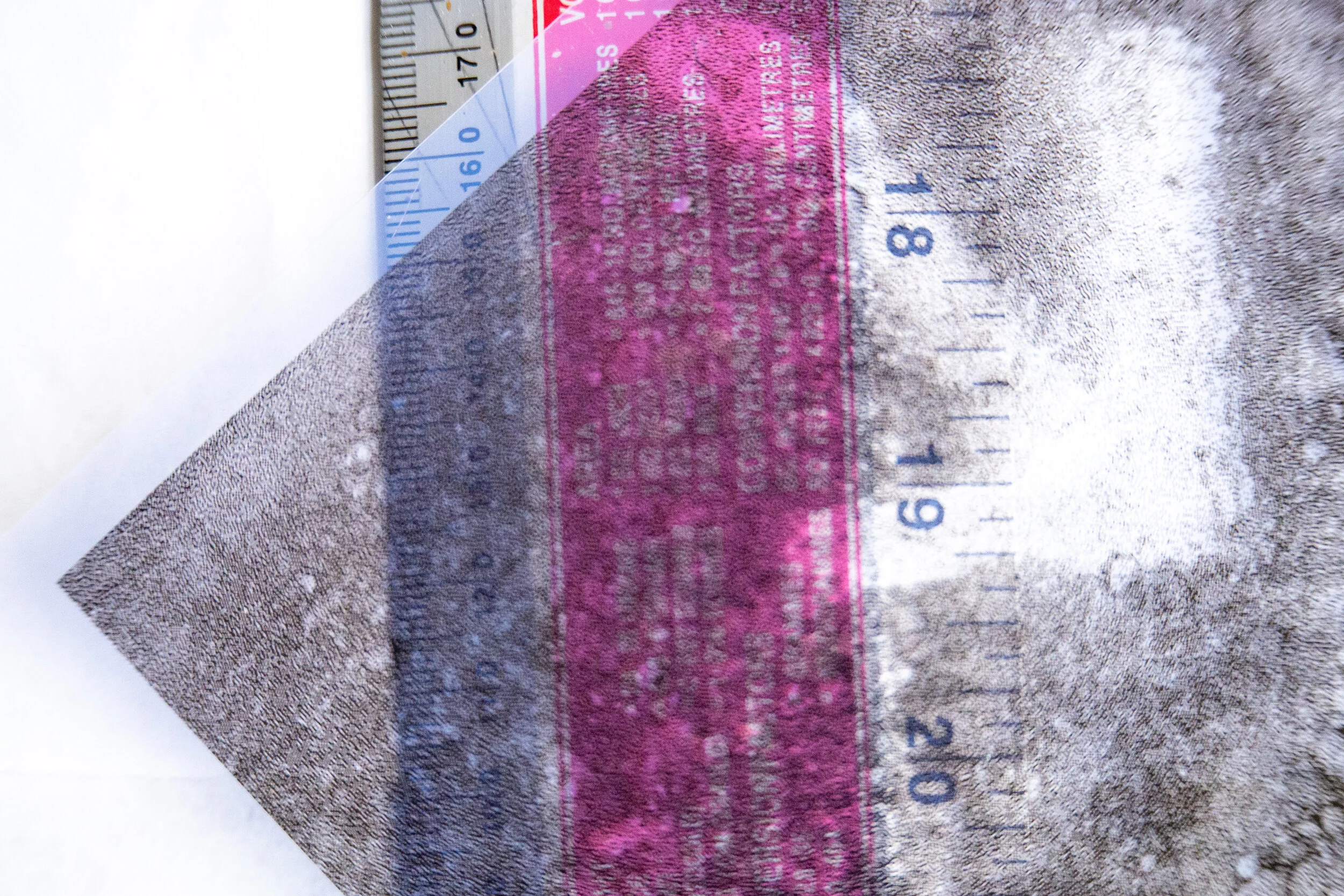
Section of acetate prepared for Calderbrook series
Meanwhile, a copper plate is prepared to receive the pixelated image, it is polished and a photo-sensitive emulsion applied. This plate is then exposed in a light box, covered by the printed acetate film so that the printed image obscures parts of the plate from the strong light.

Lightbox at Northern Print Studios
Once developed, the exposed emulsion is washed away, leaving some of the smooth copper surface exposed. When the plate is etched in ferric chloride, the exposed copper is eaten away, cutting pits into the surface.

Plate prepared for Calderbrook series
To print from this plate, it is first smeared with a thick oil-based ink, and the surface then wiped clean, leaving only traces of ink below the pitted surface.

Plate inked and wiped ready for printing
The plate is then run through a press, sandwiched against a piece of soft, dampened paper. The press- a giant electric-powered mangle with steel rollers- applies enough force to embed the plate in the paper, allowing the spongy paper to pick up the remaining hidden ink, revealing the final print.

Press at Northern Print Studio used to create these prints

Revealing a print
All these prints are printed on Somerset Antique Velvet printing paper. Many of the prints are made onto clean sheets of dampened printing paper. This appearance is enhanced by printing on top of thin ‘washes’ of coloured oil-based ink- themselves a form of monoprint. Preparing the underwashed monoprint involves applying a thin film of ink to a smooth plate, when run through the press the colour is transferred to the printing paper- a partially predictable and controllable technique.

Monoprint revealed, with acetate monoprint plate and registration marks on press bed.
Multiple monoprints can be applied, with the photo-etching plate applied last, ensuring that each layer is aligned or ‘registered’ carefully, and whilst the paper is still damp, as a wet-into-wet technique.
This gives a more fluid appearance to the final print, something closer to the quality of painting.
Calderbrook series
Today, I’m sharing three images printed from the Calderbrook plate. This is the first series from the South Pennine Paths plates.
I took the original photograph on an evening walk along a familiar road. Here, where a track met the road, the surface was worn away, and someone had taken the trouble to mark up the deficit, presumably to assist identification for repairs.
Once extracted from that context, the arrow points to somewhere important that is now nowhere in particular.

Calderbrook 24 July 2018 18:10 (i) 2020. (Photo-etching)
I’ve already used images from this Calderbrook series for the original exhibition promotion artwork and in earlier posts, this seems the right place to start.
Three of the seven available prints have made the final cut. The photo-etching itself (above) and two with underlaid monoprint.

Calderbrook 24 July 2018 18:10 (ii) 2020 (photo-etching and monoprint)

Calderbrook 24 July 2018 18:10 (iii) 2020 (photo-etching and monoprint)
Let me know what you think of the approach.
Transparent
Section from positive used for Calderbrook series
I have promised an extended piece on method, which isn’t ready. But a question came up that gives me the opportunity to explain parts of the process. The question is about what I print on and whether I can print on transparent media.
Here the answer is both yes and no. Yes, one of the preliminary stages requires transparent media: to transfer the computer manipulated image back into a physical photographic process. The image comes back into the real world on on acetate film using an inject printer. A section from the acetate used to produce the Calderbrook series is today’s picture. Here, it is laid obliquely over my metal ruler against a white background. In case you are struggling to decipher it- the spray-painted arrow here top right.
But the answer to the original question is also no, the final print from a photo-etching is achieved from the ink held in a pitted copper plate. This needs soft damp paper, usually specialist printing paper. The pressure applied is also intense, sufficient to embed the plate in the paper.
Hope that answers the question and illuminates a little.