
From Garden Centre to Generative AI
Any twenty-first century visit to a garden centre is about much more than plants. On a recent visit to one of these I paused just inside the shop, to I point out a cartoon image of a dog dressed as a human, cooking breakfast. Then I spotted another with a vacuum cleaner. Once I'd spotted one, they seemed to be everywhere. My younger companions quickly identified these cutesy images as AI generated, and dismissed them in a moment, decrying the taste and discrimination of both sellers and potential buyers. It's hard to disagree with them, but it's now also hard to ignore AI generated material.
I am already a casual user of generative AI to help in administrative tasks. I have no affiliation to or paid subscription for to any product, but I am exploring what the potential is for them. In search of some guidance I enlisted a chat bot but was shocked by the resulting line of questioning, when it asked whether I would be using the product mostly for creative writing? I knew, for example, that Hollywood script-writers were threatened enough by these tools to withdraw their labour in search for an agreement over banning these tools. Further, the controversy surrounding the 2026 Commonwealth Short Story Prize suggests many believe generative AI tools already write with literary merit. If not, the heated debate that followed about the author's own contribution is meaningless. So why were the architects of generative AI openly promoting such subversive abilities?
In search of more informed insight, I signed up for an online workshop on AI and creative writing. I expected some practical guidance, or at least some ethical discussion of these tools in creative practice. No such luck. What followed was a workshop, to a fairly standard model, one that played heavily on the significance of each individual's perspective and experience in informing the creative writing output. Fair enough, but the session remained silent on my the topics I'd hoped to explore.
That silence sadly does not remove the potential for Large Language Models and Generative AI tools to contribute to the creative process, or perhaps even their capacity to undertake such work alone. The architects of these tools are often demonised, with some justification. Suspect content is also often dismissed as AI Slop, again in many instances with some justification. But labour saving tech is tempting, so many human users are likely requesting output already, and much of it with use cases well beyond household administration.
However, some will still hold that any use of generative AI at any stage in creative work is unacceptable. Perhaps all with such views are by nature are Luddite, but the use of word processing software, capable of much more than merely recording the letters typed suggests otherwise. So does the existence and wide use of online dictionary and thesaurus. But there is a clear difference between such reference and checking tools and those that can generate page-ready text.
A further perhaps a more commonly held view that something is lost whenever generative AI is used to inform the literary endeavour. This might be driven by concern about the questionable ethics of sourcing LLM content, or over delegation of intellectual activity by the writer. Does this mean that generating ideas should be off limits? What about producing lists of potential near-rhyming words, or perhaps alternatives for the rhythm of a line? The case for considering the legitimacy and implications of using generative tools is pressing.
I don't have a fixed view on any of these questions yet, and have limited experience from which to make a contribution. It seems likely that writers, or readers, will disagree on this topic. But debate remains urgent for everyone who creates.
On taxidermy and related matters
Passing an antique shop while on holiday, I stopped to take a look at some coloured glass in the window. Beneath that vase, and just inside the shop a taxidermist's case rested on an upholstered chair. It was packed tight with butterflies and moths, pinned with some regularity but without a clear rule. The freshness of colours and dark hardwood of the frame suggested the case had seen little daylight.
In the days since that trip, as I select poems to submit for a pamphlet competition, this case has come to mind. I find myself wondering whether this was all she had, this collector? And assuming there were more, how had she decided what was worthy to include, and what of the other insects she had sacrificed? How many moths were there among the butterflies? And why, other than its outstanding beauty include that one silken blue among so many earthy browns and warm oranges?
I'm never likely to get a chance to these questions answered by this collector, identified as Victorian in the shop. But as my submission deadline draws closer I find myself discarding some stronger work, and rethinking the relevance of older work. And in doing so I realise my questions have more to do with taste and coherence, than about taxidermy.
Writing alongside painting
Writing has taken much more of my creative energy in recent months than painting- participating in Faber Academy’s fine Writing Poems course, held for the first time in Newcastle. So, when I would usually head to my studio (an early start) I’ve been heading to a writing chair instead. I’ll explain the route to poetry in my next post.
In some cases, the link between poems and the paintings is very explicit. For example, my last post included a painting about exploring Heptonstall’s churchyards. I’ve now written a complementary poem, with the same title:
Searching for her resting place
Approaching the first
and shattered shell,
an uneven pavement
of outsized tombstones,
discards of some
supernatural storm, now
covering what remains of
so many
Greenwoods
and Chatburns
among the tens of thousands
persisting here.
These broken bulwarks
catch rain drops as they fall
from empty archways,
etching grit in steady trickles.
Now step
out well beyond these
high enclosing walls
where
crazed crosses and,
Sycamore boughs
and tangled wire
mark the intake’s edge.
Look
where
between Southworths
and Speaks
her name’s embossed,
then clawed away,
some craving conscription
of those fierce flames.
Some resting place!
More passing-place
for lives incomplete.
And finally, if you are unfamiliar with this place- a couple of photographs as well…


Spring delayed
Two new paintings- both developed from my sketching trip to the South Pennines in March. The temperature was mild but rain was rarely far away and the wind on the tops made for arduous walking.
Spring certainly seemed close, but perhaps further away on the high exposed open moorland.
I’m still working from the photographs and sketches I took on that trip- and here are two from the margins of moorland villages.
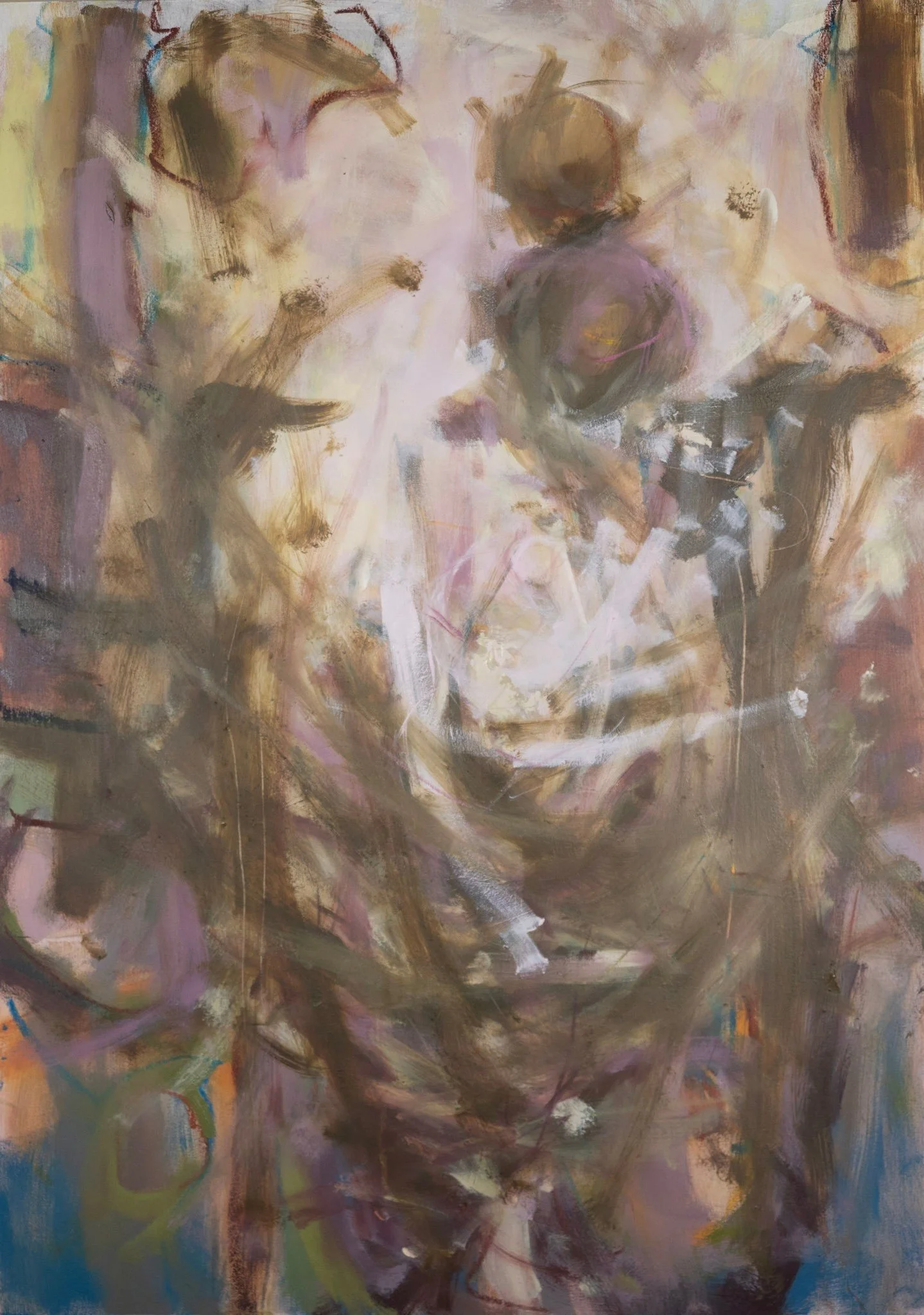
After testing the ropes- over Hebden Vale (2023) Oil on panel

Searching for her resting place (2023) Oil on panel
Revisiting the familiar
Before the start of spring, while the trees were still bare, I took a trip to the South Pennine hills between Yorkshire and Lancashire. The wind and the rain restricted my activities a little. I came back footsore, with a very damp sketchbook and fewer photographs than I’d planned. But the visit helped recover my affection for and interest in this place, its moorland, valleys and streams I have known well. This landscape has been the subject of my artwork in recent years- up to the photo-etchings I made in 2019/20.
These photographs are now up on my studio wall, and I am now painting with the benefit of these and my sketches, the first of which I’ve included here.

Over Wadsworth Moor (2023) 41x30cm Oil on paper

Rippling outwards (2023) 41x30 cm Oil and acrylic on paper